Measurement, correction, and a line of audio tools, built solo from a desk in Montana. I'm Jamey: twenty-five years in audio, soldering benches at Grace Design, then HeadRoom as CEO. Now I measure headphones on my own bench, publish what the rig says, and build the software that puts it to work.
Products I took from idea to working software myself: the DSP, the interface, and the calls about what ships. Level is shipping; Attune and Tone Farm are in free beta.
Every correction you can buy is built from somebody else’s sample of your model. Send yours and get the curve of the pair actually in your hands — published either way, flattering or not.
Measured on a miniDSP EARS Pro, seated for best fit and labelled by rig, back to you in about a week — and it gets its own page here, credited however you like. Unit variation is real, and your pair’s exact curve is what Attune turns into a personal tuning.
Two more things built here: the open field manual on how headphones work, and an iOS app. Click either for the detail.
Because the method is written down and you can check it. Every headphone is seated deliberately, for the best fit — adjusted for seal and for sound, the way you adjust a headphone before you settle in to listen — not dropped on at random. Most published measurements average a handful of careless placements together. We think that answers the wrong question: you don't listen at a random seating, you listen at the one you fiddled your way to. So we measure the good one, then prove we can find it again.
What gets published is one real seating, never a blend of several, chosen by a stated rule. Both channels are measured and kept. The rig, the seating procedure, and the repeatability numbers go on the page next to the curve, including the parts that aren't flattering — where the fixture stops being trustworthy, and how far the line moves if you seat it again. A measurement you can't audit is just a picture of a line.
Background, for what it's worth: I was employee #1 at Grace Design, where one of my jobs was building the automated measurement system the gear was tested against, and I later ran HeadRoom as president and CEO. It's why I care about this, and it's how I learned what a bad measurement looks like. It isn't the reason to trust the graph — the method above is.
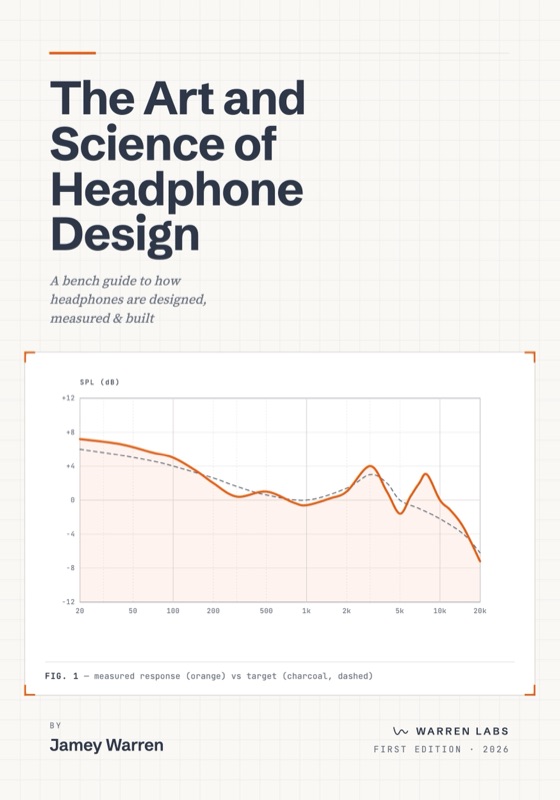
I wrote The Art and Science of Headphone Design, a bench manual on how headphones actually work, from driver physics to measurement and tuning. The full reference is free and open at makerphones.com. There's also a print and Kindle edition for anyone who wants it on the bench.
Production, testing, repair, prototyping, and the automated measurement system the gear was tested against. Two founders and me, to twenty people and gear in studios worldwide.
Relaunched the entire headphone-amplifier line: every model from concept through prototype into production.
An independent line of audio tools and an open headphone field manual. Running the whole product chain myself, in the open, so you can see exactly how I work.
Every product above ran this chain, idea to shelf — the measurements, the DSP, and the calls about what ships. It’s also what I’m hired for, one stage or the whole path.
What's actually worth building: the real problem, the honest market, the thing only you can pull off.
Settling the feature set and holding the line. The best calls are usually the things left out.
Who actually buys it and why, what it costs, and the story that lands it in the right hands.
Prototype to production. Hardware and software, sketch to shelf, including the places it tends to go sideways.
If you’re building a headphone, I’ll read one from the outside — measured, listened to, and written up. Occasional work, taken a few times a year.
Send me a prototype or a shipping unit. I measure it, listen critically, and deliver a written report on what the design is doing, what it's trading off, and what I'd change.
Tell me what you're working on, and I'll let you know honestly whether I'm the right fit.